Is Your Phone a Gilded Cage? Dr. Nicholas Kardaras on Tech Addiction & The Matrix | Teens Wanna Know
What nobody is telling you is that the device in your hand right now was designed to be as addictive as a slot machine, and your mental health is the price of admission. Here’s the truth about tech addiction: it’s not just a “bad habit”—it’s a clinical crisis where your brain’s natural curiosity is being weaponized against you. To get to the bottom of the “digital madness” and the rise of the loneliness epidemic, we sat down with Dr. Nicholas Kardaras, CEO of the New York Center for Living and one of the world’s leading experts on adolescent mental health. An Ivy League-educated psychologist and author of Glow Kids, Dr. Kardaras has spent over twenty years treating the extreme fallout of the digital age—from tech-induced psychosis to the ways Big Tech intentionally ignores user harm to keep engagement high. If you’ve ever felt like the algorithm knows you better than you know yourself, you need to hear why he says today’s teens are being “enslaved” by a sugar-coated cage—and exactly how you can break out.
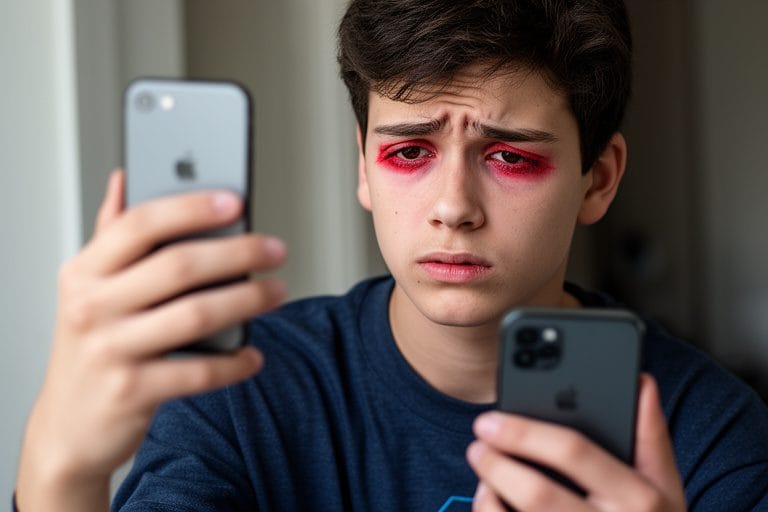
At what point does normal phone use become actual addiction in teens?
Any addiction is typified by a person engaging in a substance or in a behavior even though it’s causing harm to their day-to-day lives. It could be negatively affecting their school life, their relationships, their health, their work, but you still keep engaging in that behavior anyway. So typically, if you can’t put your phone down and it’s causing you harm, but yet you still keep doing it, you might have a problem–you might have an addiction to your phone.
What’s happening in the teen’s brain when they can’t stop scrolling?
Scrolling taps into what’s called the dopamine reward system also known as the dopamine reward response in our brains. Every time we experience something pleasurable, it lights up our dopamine. It gives us a little bit of a dopamine tickle, and then we want to repeat and chase that experience. So when we scroll, we keep chasing that additional dopamine hit.
There’s another concept also called Neophilia. It’s the love of something new. We’re hardwired to be curious and to explore and seek new things—it’s what kept us alive as a species—we explored new and more habitable places live, new ways to farm, we invented tools—all these “new” things kept our species alive. So we’re hardwired explorers…to see what’s just over the horizon; to open up Christmas presents on Christmas morning. So scrolling is like a new gift that we are curious about that we just can’t help ourselves from seeing what’s next. We are hardwired to be really curious as to what’s just beyond the scrolling horizon. It also taps into our dopamine reward system in a way that can become really habit forming.
Are apps like TikTok and Instagram intentionally designed to addict users?
Absolutely. There is no accidental addiction here. TikTok and Instagram are not only intentionally addicting users, but as a result of the Facebook whistleblower, Frances Haugen, who worked at Instagram, we know that they are aware that they are harming users and not willing to stop. She released their internal emails about their internal research showing that Instagram was causing harm and increasing suicidality in adolescent girls. And the internal emails showed a conversation where there was a suggestion to decrease the harmful aspects of the algorithm to make it less addicting, because they knew it was addicting and that it was causing harm. And the response was absolutely not. If we make the algorithm less addicting, it’s going to, of course, decrease engagement. We don’t care if it’s increasing suicide rates.
So they’re aware that it’s addicting, but not only are they aware that it’s addicting, they’re aware that it’s harmful and they’re still doing it.
What’s the number one warning sign a teen is already addicted, but doesn’t realize it?
There’s a lot of emotional volatility with addiction. So people get very emotional and dysregulated, explosive, angry. You also start seeing the telltale signs in other parts of their lives beginning to suffer. So relationships suffer, grades suffer. Wellbeing and health begins to suffer. Sleep is also a big one. Sleep deprivation kicks in because you’re up all night mindlessly and addictively scrolling. Those are the telltale signs.
You mentioned sleep and mental health. How bad is the damage you’re actually seeing?
I’ve seen extreme cases where people have been sleep deprived for multiple days and have had full-blown psychotic episodes where they’ve blurred reality with their digital media; where they were fully in the matrix and didn’t even realize that they were in the matrix. I’ve seen cases where sleep deprivation that has led to violence, people blurring reality and getting paranoid, getting violent as a result of some of that digital immersion. So it can get pretty bad. Obviouslty not everyone gets violent—those are the extreme cases. But many of the clients that I work with have flunked out of school, lost their jobs, lost their relationships and are in the proverbial basement, alone with their computer…their lives having become very small.
Is tech addiction worse today than substance addiction for some teens?
Interestingly, the trends for substance addiction for adolescents have been skewing down over the last few years, but of course, as we all know, screen usage, the dopamine drug, has been skewing way up. So in that sense, tech addiction is worse because it’s more insidious, pervasive and ubiquitous.
It is causing significant mental health harm because, in the social media age, we’ve seen suicide rates double. We’ve seen anxiety hit record levels. We’ve seen ADHD double. So it’s causing harm. In that sense, tech addiction can be worse because I think it’s affecting a much wider population of young people (around 98-99% of teens by some estimates) where substance abuse in teens affects a smaller percentage of adolescents.
What’s the fastest way a teen can reset their brain if they feel hooked?
Unplug. Doing a digital fast or digital detox is the best way to reset your brain to go back to baseline. The research shows you need about four weeks to get your dopamine levels, your serotonin levels, your endorphin levels to go back to their normal baseline because essentially screen time acts as a stimulant that affects your neurochemistry. It doesn’t reset itself in a day, but unplugging, at least beginning to do one day a week detoxes can be helpful.
Starting by unplugging one day a week, like a Sunday that can be an unplugged day, is huge because even with just that one day, you can begin to own your life again. You can start to see the impact that screens are having and feel a sense of control over your day-to-day life. So if you can’t unplug for four weeks, which most people can’t, at least unplug one day a week and have it be a screen-free day where you get outside, touch grass, hang out with friends, play some sports or music. That’s one of the biggest suggestions that I can make.
How do parents make this worse without realizing it?
A lot of times, the teens that I’ve worked with get hooked on their platforms because they’re using it as an escape from overbearing parents. So if you’re a helicopter parent, land the helicopter and give your kids some breathing room, because the screen time can be an escape. We work with young people in my treatment programs, and they’ll often say, “If my parents gave me some more space, I wouldn’t need to escape from them.” The other part of the parent equation is the parents’ own digital habits.
Nobody likes hypocrites, so a parent telling a teen to watch their screen time, while they’re constantly on their devises not only sends the wrong message, but it can create a lot of resentment. So parents need to be self-aware of what they’re modeling. Pour love and attention into your child and be fully present. It’s not quantity of time that counts, but quality. You can spend a lot of time with your kids, but if the parents are on their devices while their kids are also on their devices—that’s not really spending quality time together. They’re alone together.
Is AI making this problem better or way more dangerous?
I’m doing a whole thing about AI relationships right now. AI is making things significantly worse because it’s making the algorithms that target psychological vulnerability and social media much more precise. A lot of social media algorithms will target what they detect that a user wants to view, and sends content curated towards that. But oftentimes social media tries to increase the emotional response of the user because that increases engagement. Algorithms can now much more accurately dissect and analyze a person’s user profile. So if somebody’s self-conscious about body image, about self-harm, about whatever that may be, then like a heat seeking missile, the AI fueled algorithm can now more effectively and dangerously harm that person by sending them content that makes their mental health issue worse. AI is now also problematic because it’s seductive and talking to AI bots may be easier than a real life relationship.
I’m doing a lot of work with people that are developing relationships with AI and it’s frictionless. The AI bots that are almost sentient now are really effective surrogates for people that are going through the “loneliness” epidemic. So if you’re lonely and you need a companion, but you have social anxiety and you don’t know how to interact with people, it can become really attractive and seductive to develop an emotional relationship to an AI bot or an avatar.
If you had to give one brutal truth about teens and tech use today, what would it be?
That teens have been enslaved by their tech usage and they don’t even realize it because the cage that they’re being enslaved in is a sugarcoated cage that feels good. It’s a gilded cage. So teens want agency. They want autonomy. They don’t like their parents telling them what to do, but guess what? Teens today have had Big Tech telling them what to do, what to think, how to vote, what to value, how to experience the world and how to process and live life. So I think teens are having their lives and their freedoms stolen from them by manipulative Big Tech companies that are monetizing them and they don’t even know it.
Like Neo, they’re in the matrix and don’t even know it.

Dr. Nicholas Kardaras, the CEO of the New York Center for Living, is one of the country’s foremost experts on adolescent and young adult mental health, tech addiction, and the clinical impact of the digital age. The Ivy-League educated psychologist, and best-selling author has over twenty years of both clinical expertise and operational experience creating, developing, and running pioneering and nationally recognized treatment programs. Dr. Kardaras was the Founder and CEO of Omega Recovery in Austin, TX and Maui Recovery in Hawaii, as well as being the Executive Director of The Dunes in East Hampton, one of the country’s premier drug and alcohol rehab centers. He is a Clinical Professor at Stony Brook Medicine’s School of Social Welfare and the author of the best-selling Glow Kids (St. Martin’s Press, 2016), Digital Madness (St. Martin’s Press, 2022), and How Plato and Pythagoras Can Save Your Life (Conari, 2011). Dr. Kardaras has worked with both state legislators and members of Congress to help enact legislation to protect the mental health of children, teens and young adults. https://centerforliving.org/